Europeans don’t road trip, they grand tour.
Inspired by that vibe, I organized an overseas excursion to motor along some of the world’s most picturesque roads. Starting from the absurdly quaint Cotswolds, my plan was to mainline countryside culture in a trio of quintessentially British machines: the rough and tumble Defender OCTA, the O.G. Chelsea tractor Bentley Bentayga, and the überwafty Rolls-Royce Ghost. Since I’d be 8 hours ahead of Pacific time, I would explore key European destinations during the day and catch up on work at night.
I brought along two new aviation-themed Bremont timepieces to complement my borrowed rides: a titanium-on-titanium Altitude MB Meteor and a steel-on-leather strap Altitude Chronograph GMT.
The first thing you’re likely to hear about the Costwolds is the uncanny uniformity of its Jurassic-era limestone, a hue that permeates the local architecture and verdant hillsides. Topping off these consistently colored ancient structures are mossy slate roofs, whimsical chimneys that seem plucked straight from a children’s book, and a slightly miniaturized proportion that makes each passing village feel like a subscale set piece.
These pastoral landscapes have an almost subliminally calming effect, especially when the scene is filling the windscreen of a Bentley Bentayga V8 S. This luxe multitool of a sport ‘ute couples a locomotive-like 568 lb-ft of torque with the quiet refinement of a 3-ton living room—precisely the sort of kinesthetic paradox that put the 106-year-old carmaker on the map. However, my first impressions of my borrowed matte black Bentley leave me conflicted. I’m usually a sucker for mile-deep metallic paint jobs and old school veneers; in my view, this particular specimen’s satin black exterior and diamond carbon fiber interior trim don’t do justice to the brand’s hard-earned reputation for painstaking hand craftsmanship.
My feelings, however, appear to be irrelevant to the vast majority of the British population. Passersby, onlookers and fellow motorway warriors pay respect to my steed as though the late, great Queen herself was behind the wheel. The approval is palpable. The Bentayga’s command of Britain’s b-roads also makes it easier to let its postmodern aesthetic slide. Mat the right pedal and the HMS Bentayga devours space and time with effortless alacrity, shrinking distances in a way that makes same-day multi-city visits entirely viable. Solid visibility, tomb-like quiet and accommodating massaging seats further assert its road supremacy, never mind the fact that it feels oh so proper to pull up to a grandiose Cotswolds destination like Blenheim Palace in a Flying B. Given the escalating who’s who of celebs and royals in the Cotswolds’ cozy hamlets, the Bentley makes you feel more like a local than a tourist, even if its multimedia interface and hard-to-disable safety nannies prove more distracting than they should be.
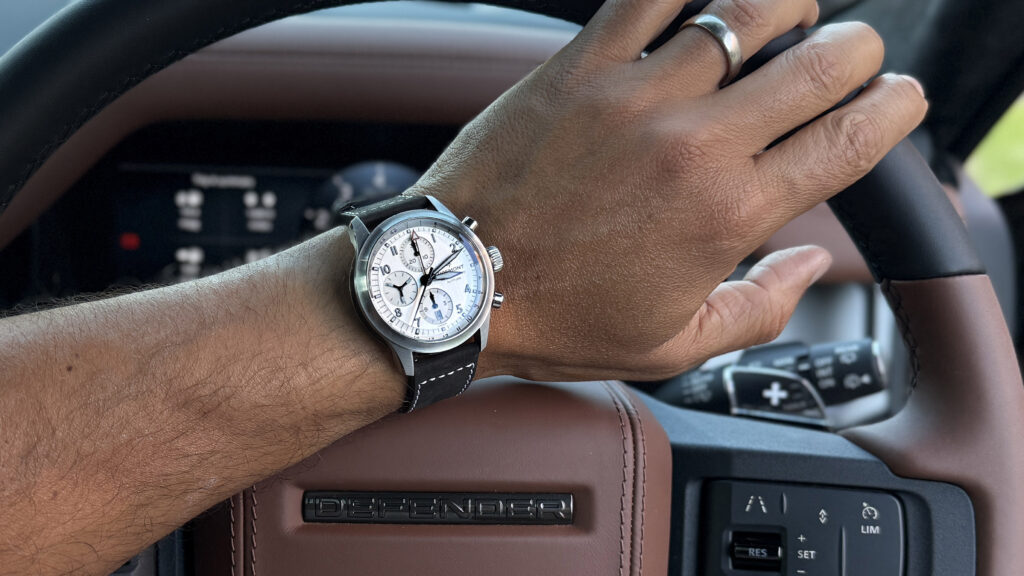
Like four-wheeled divining rods, the Bentayga gravitates toward the leather and steel Chronograph GMT while the titanium-bodied Meteor feels more at home in the Defender. The nearly $275,000 Black Edition Bentayga is like a macro-sized echo of the $6,300 Chronograph GMT, despite this example’s departure from the brand’s aforementioned leather and wood tropes. The Chronograph’s brushed silver dials offer a subtle contrast thanks to the sub-dials’ slightly different tone. Details like Arrow-tipped GMT hand and triple-propellor small-seconds help distinguish this model while the leather strap lends it a more terrestrial, handcrafted feel in contrast to the Titanium Meteor’s more purposeful design. There’s also a bit more jewelry to the Chronograph’s finishes, drawing inspiration to pretty, purposeful pieces like the Tag Heuer Carrera Chronograph. While the 14.7mm case depth is meaty, it’s slightly slimmer than before (though still chunkier than the Meteor’s 12.23mm measurement). The Chronograph’s stainless steel case incorporates a DLC-coated center barrel in black, housing a chronometer-rated, Sellita-based BC781 caliber with a 62-hour power reserve.
Unlike the curiously styled but driver-focused Bentley, the $160,000 Defender OCTA’s mission is ultimate off-road badassery via its take-no-prisoners stance and trick hydraulic air suspension system. Thanks to its 626 horsepower twin-turbo V8, this is also the most powerful Defender in history. However, it’s easy to feel blissfully aware of the Rover’s oversized skillset when piloting this extra wide five-seater on narrow country lanes, as it rides with the plushness of a hot-rodded Cadillac on stilts and doesn’t reveal the depths of its powerful engine unless provoked with an angry stab of the accelerator.
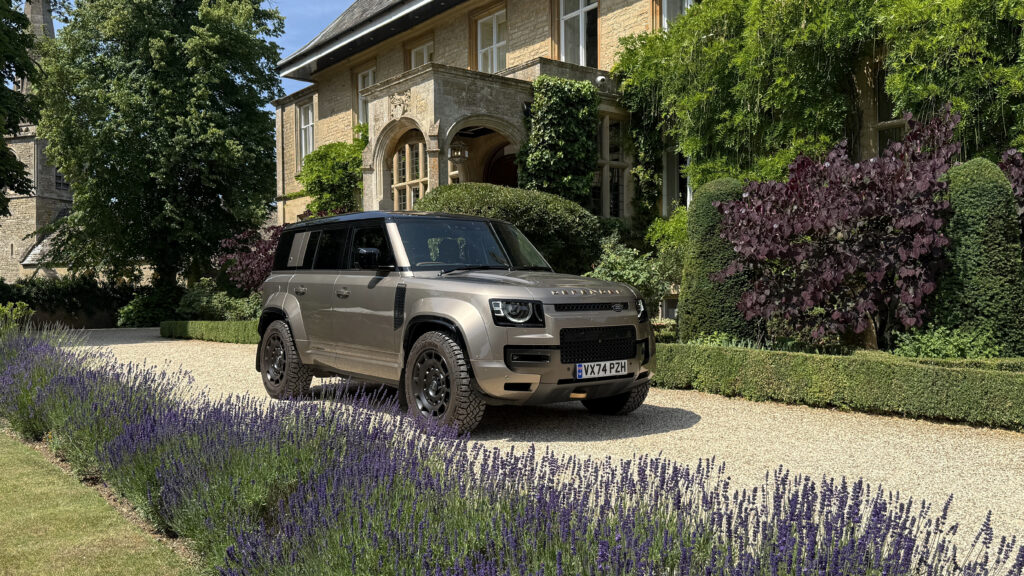
I first learned of the OCTA’s otherworldly offroad capabilities at the truck’s media launch in South Africa earlier this year. Sadly, its knack for river fording and rock crawling is likely lost on most Cotswolds denizens; most Defenders here (and throughout much of the world) are pristine boulevardiers, though I did spot one or two in the wild en route to hunting expeditions. The Defender is like a more accessible—albeit starting at a still-pricey $152,000—alternative to the posher Bentley. While the Defender’s go-anywhere ruggedness and Tonka toy proportions suit Bremont’s full metal Meteor, the truck’s shiny black plastic trim bits don’t quite live up to the larger-than-life promise, at least aesthetically. Dollar-per-pound, the 53 gram, $5,700 Bremont is nearly 2,000 times pricier than the nearly 3-ton, $152,000 Defender. Considering those economies of scale, every square millimeter of the Bremont had better be on point—from the knurling on the twin crowns to the satisfying click of its bezel. The brand’s so-called Roto-Click technology is said to have been refined with a more precise action, which is a good thing considering competitors include the likes Tudor and Fortis. The clicking does feel addictively satisfying, inspiring unnecessary spins of the crown just for the haptic heck of it. Also gratifying is the new titanium bracelet whose deployant clasp snaps shut with a delicious snick.
The OCTA’s imperiousness on Britain’s narrow country lanes make up for its chintzy body bits. If anything, the watch’s strict functionality aligns tidily with the Rover because the truck’s DNA is distinctly its own. Unlike Bentley, whose SUV is an evolution of a platform shared with multiple nameplates (Audi, Lamborghini and Porsche), Land Rover traces its lineage directly back to 1948’s military-inspired Series 1. Along similar lines, Bremont’s 2007 collaboration with Martin-Baker ejection seats meant they could engineer their MB line of watches to survive getting jettisoned from a jet, a crucial brand differentiator in an industry where legitimate heritage is everything. Like the Chronograph, the Meteor features the brand’s signature Trip-Tick case, a distinctive element that incorporates three-piece construction with an anti-magnetic protection via a soft iron ring and a flexible interior rubber mount to ensure those pesky aircraft ejections don’t damage the movement. Both 42mm cases now incorporate reduced lug-to-lug distances of 22mm for reduced clunkiness, a concave bezel for a more understated effect, and 1mm-smaller case diameter for a less imposing overall proportion. The pieces are also slightly lower profile while retaining enough of the Trip-Tick’s chunkiness to make them still feel substantial.

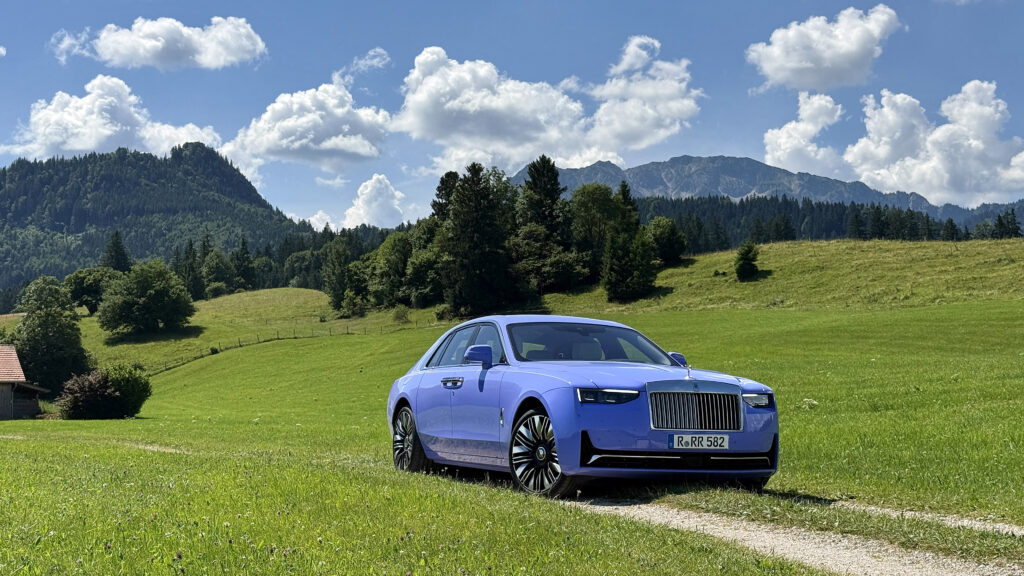
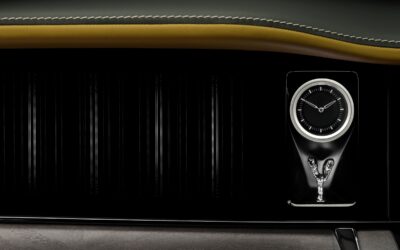
While my premium SUV duo possesses an implicit intention of utility, the Rolls-Royce Ghost Series II I pick up in Munich is an elegant expression of full and complete excess. Finished in a shade of Boracai Blue reminiscent of blooming jacarandas, the 18-foot sedan is a visually shocking departure from its straightlaced surroundings. When pick up the Ghost upon arrival in Munich, Germany, the locals ogle my borrowed Roller discreetly; the reluctance to let on that they’re eyeballing this oddity is palpable. By the time I’m passing slower traffic on unrestricted sections of Autobahn, the twin-turbo 6.75-liter V12 tugs this $320,000 chariot ahead with hushed-yet-urgent thrust leaves fellow travelers quizzical. Perhaps the Roller’s most paradoxical state is at full tilt, whooshing along at its maximum velocity of 155 mph while holding a conversation in hushed tones.
I had vague concerns about entering France with the big bad Roller. After all, weren’t there “Yellow Vest” protests here that destroyed a slew of luxury cars? Turns out the Gauls aren’t full of gall; the predominant response to my garish ride was awe, fascination, and spontaneous grins and thumbs ups. Also telling was when I drove it to Bugatti headquarters in Molsheim and was granted prime parking on their historic grounds. Not bad for a ride that costs a fraction of the multi-million Euro cars produced at their atelier.
After weeks of touring in these vehicles with oversized personalities, I swing by Bremont’s 35,000 square-foot manufacturing and technology center for a tour and a quick hello with CEO Davide Cerrato. This floor-to-ceiling glass windowed structure, dubbed The Wing, is part Bond villain lair part man cave, decorated in everything from Ewan McGregor and Charley Boorman’s round-the-world BMW GS motorcycles to the flight deck of a British Airways 747-400. Located in Henley-on-Thames, the property is bordered by a polo field and forested land—just the sort of fantasy milieu that drew me to the United Kingdom in the first place.
In retrospect, the Defender and Bentley feel like real British icons, dominating the roads and dwarfing lesser vehicles that lack their oversized footprint and planetary gravity. This is the sort of effect that usually goes unnoticed in large cities but dominates the countryside; away from the urban centers, big expensive SUVs just hit different. On the other hand Rolls-Royce delivers unparalleled shock and awe, especially in locales unaccustomed to ultraluxury sleds and, perhaps more interestingly, long stretches of Autobahn whose left lanes are typically dominated by supercars. In contrast, the Bremont timepieces come across as quiet luxury, like subscale emblems of aspirational ruggedness expressed in their newly redesigned and incrementally more understated forms. Their subtle streamlining—the more accommodating ergonomics, the concave bezels, the incrementally more elegant design— are like wearing a tiny slice of Brittania on your wrist which, unlike a luxury car, you can carry with you anywhere in the world.